Footsteps of Flourishing: Finding Well-Being through Engagement
Have you ever been so absorbed in an activity that you lost track of time, forgot to check your phone, and felt both energized and content afterward? If so, congratulations! You’ve experienced flow. That’s part of the essence of engagement, the second pillar in positive psychology’s PERMA model of well-being:
P – Positive Emotions
E – Engagement
R – Relationships
M – Meaning
A – Accomplishment
In a previous blog post, we explored how positive emotions like joy, gratitude, and love fuel flourishing. Now, let’s dive into engagement, the experience of being fully immersed in the present moment, where your skills meet the perfect level of challenge.
🧠 The Science of Engagement and Flow
Engagement isn’t necessarily the same as being busy. It’s about that beautiful balance between challenge and skill: when what you’re doing is hard enough to be stimulating, but not so hard that it feels impossible, while overlapping with something that maintains your interest. One of the founders of positive psychology, Mihaly Csikszentmihalyi described this state as flow, and it’s a sweet spot where attention, energy, and joy meet. It’s highly associated with work that is high in skill variety and autonomy. Flow is that perfect balance between boredom and cognitive overload.
Flow can happen during work, art, sports, or even daily tasks such as painting, gardening, coding, or having an inspiring conversation. Studies show that entering flow is linked with:
Lower stress and anxiety (Fullagar & Kelloway, 2009)
Higher well-being and life satisfaction (Asakawa, 2004; Csikszentmihalyi, 1990)
Improved brain health, including better emotion regulation and focus (Ulrich et al., 2021)
When you’re in flow, your prefrontal cortex, which manages self-criticism, self-reflection, and time awareness quiets down. This allows creativity and intuition to take center stage. That’s why after a deeply engaging experience, people often remark how they feel more alive.
⚙️ The Skill-Will Matrix: Where Engagement Thrives
In workplace psychology, engagement can also be viewed through the Competence and Commitment Matrix — a simple model that maps where tasks fall based on the individual’s competence (skill) and commitment (motivation) to the task.
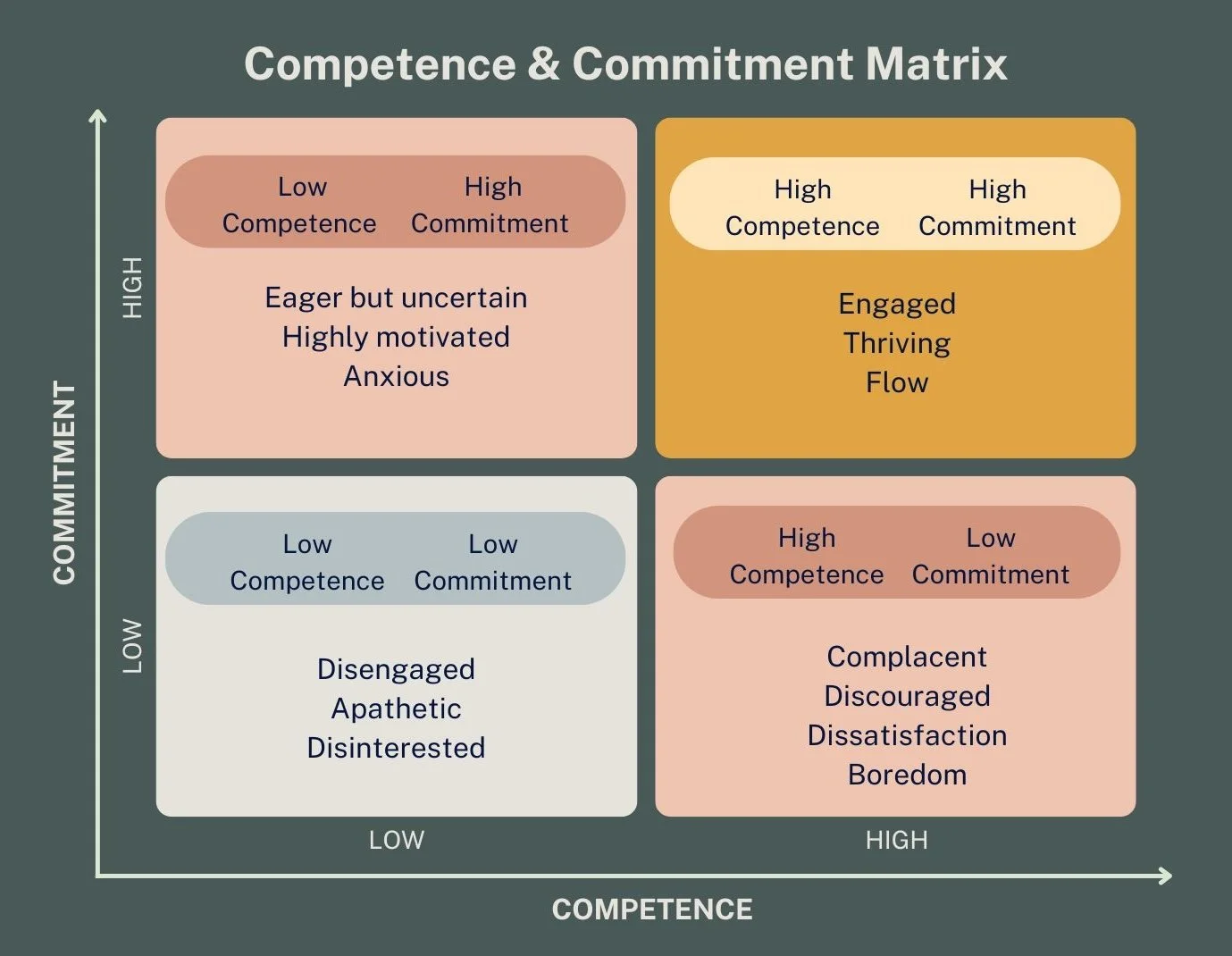
The upper-right corner (High competence / High commitment) is where true engagement happens. When you’re both capable and motivated, you experience flow more easily.
This model isn’t just for work. It applies to every area of life.
In fitness, it’s when your workout challenges you but doesn’t trash you.
In hobbies, it’s when you’re improving just enough to stay curious and come back for more.
In personal growth, it’s when you feel both competent and inspired.
The goal isn’t to live there 100% of the time, but to notice when you drift out of it and gently steer yourself back. And also to be sure to remember to plan activities that engage in flow moments.
What Engagement Really Looks Like in Everyday Life
Engagement in the PERMA model of well-being isn’t just about finding your “flow.” It’s about finding opportunities to be so involved in something that you feel energized doing it. But let’s be real: not every task is going to feel magical (we all get to do the dishes). Still, the more often we tap into engagement, the more fulfillment, joy, and resilience we build into our days.
🔍 Quick distinction
While flow is that ultra-absorbing, almost out-of-body state where everything clicks, engagement is the broader experience of being mentally, emotionally, and physically invested in what you’re doing. Think of flow as a bonus level that you reach through engagement.
According to Schaufeli et al. (2002), workplace engagement includes three components:
Vigor – energy, stamina, and the ability to bounce back from challenges.
Dedication – a sense of purpose, passion, and pride in your work.
Absorption – being deeply focused, to the point where time flies.
💡 When these ingredients are present you’re more likely to unlock a state of flow. And even when flow doesn’t happen, those engaged moments still add up to greater well-being.
Let’s look at other examples of what that can look like in real life:
🎨 A painter who spends hours blending colors on a canvas, completely unaware it’s already dark outside.
🪴 A gardener who loses herself in arranging perennials, finding calm in the rhythm of tending soil and snipping leaves.
🎸 A musician practicing the same passage over and over until the notes come effortlessly, savoring the process.
📚 A teacher who lights up while explaining a tough concept and sees the spark of understanding in a student’s eyes.
🧶 A knitter, barista, coder, or volunteer; all deeply immersed in doing something they choose, something that matters to them.
Notice how none of these require a “perfect” setting. Engagement isn't about being constantly entertained or stress-free. It's about showing up, getting into the zone, and letting yourself care about what you’re doing.
Engagement can also be messy. It might feel frustrating or hard at times, but it’s the kind of hard that feels worth it because out of that comes growth, and from growth comes joy.
Why Engagement Is Essential for Well-Being
When you’re engaged, your brain experiences a harmony between focus and fulfillment. Research shows that regular engagement contributes to:
Lower stress and depression by regulating the body’s stress response.
Higher motivation and job satisfaction.
Enhanced resilience, helping you recover faster from setbacks.
The more engaged you are in meaningful activities, the more energy and creativity you have for everything else in life.
💡 How to Build Engagement Into Your Day
1️⃣ Notice What Absorbs You
Think back to times you’ve been completely present. Maybe you were reading, cooking, organizing, or even brainstorming ideas.
Ask yourself:
What was I doing?
What skills was I using?
How did I feel afterward?
💬 Write down two or three activities that make you lose track of time.
2️⃣ Match Skill to Challenge
If you’re bored, raise the challenge slightly.
If you’re overwhelmed, lower it.
Examples:
Too easy: You’re running the same 1-mile loop daily and getting bored.
Adjusted: Add a new route or pace to re-engage your body and mind.
3️⃣ Eliminate Distractions
Engagement requires presence.
Try a digital detox window of even just 20–30 minutes of uninterrupted time.
Turn off notifications, close extra tabs, and immerse yourself in one thing at a time.
4️⃣ Engage Your Strengths
When you use your signature strengths, engagement happens naturally.
Take the VIA Character Strengths Survey to discover yours then look for ways to use them daily.
If your strength is curiosity, learn something new.
If it’s kindness, volunteer or mentor.
If it’s creativity, set aside time to make something beautiful.
5️⃣ Schedule “Flow Breaks”
Plan short moments of deep engagement throughout the day not as chores, but as energy resets.
Examples:
Morning: Journaling or stretching
Afternoon: Focused project work
Evening: Cooking, art, or play
These “micro-engagements” can reduce fatigue and improve focus.
🌟 A Gentle Challenge for You
Today, choose one thing that truly engages you, and give it your full attention for 15 minutes. Then write down how you felt afterward. Because when you cultivate engagement, you’re not just managing your time, you’re enriching your life.
References